
The Latest Study Validated What We've Been Saying: Spiky Profiles Matter More Than Diagnosis
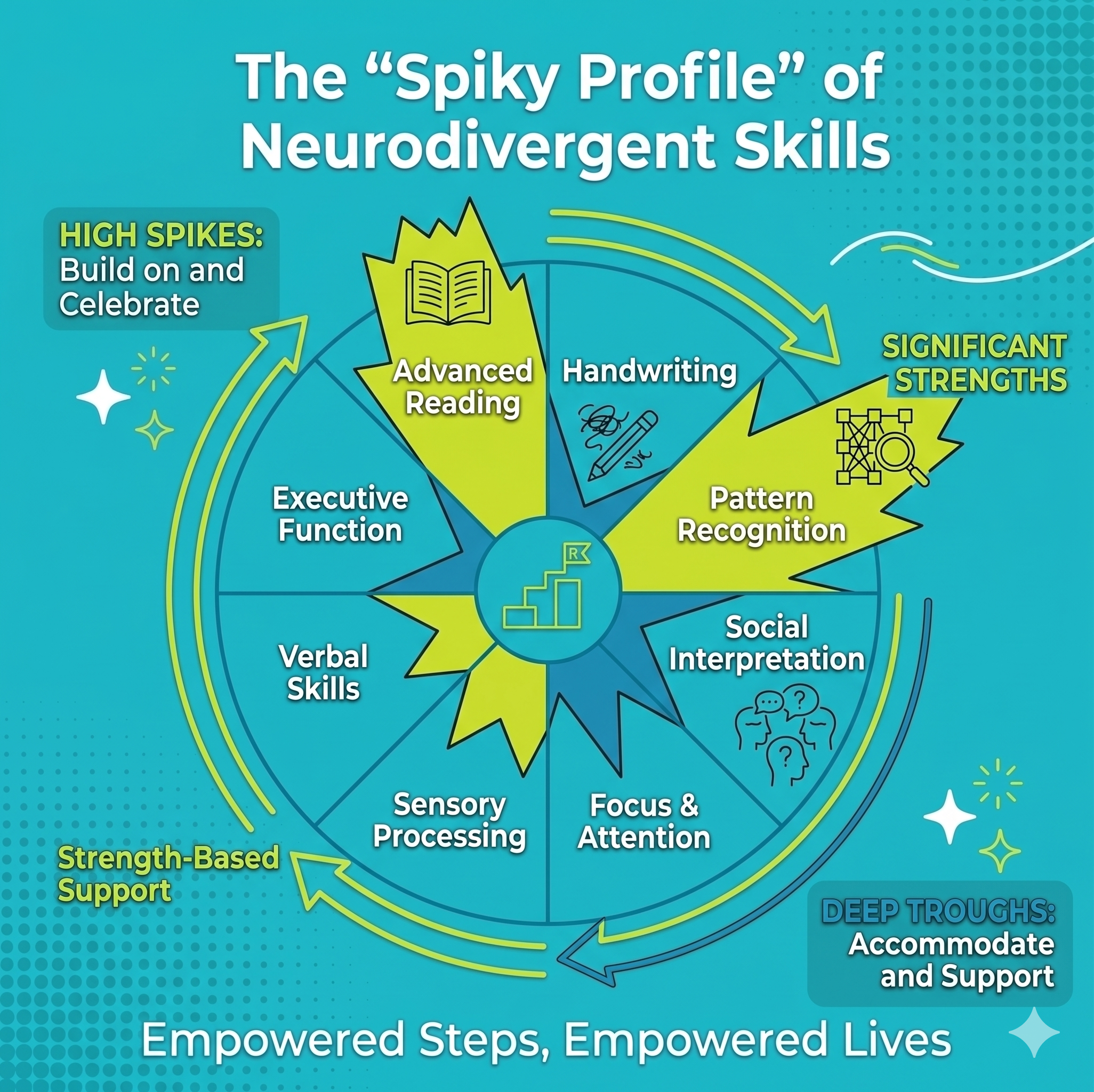
At Willful Steps, we’ve taught that neurodivergent people don’t have flat, even ability profiles - they have Spiky Profiles.
Some areas are exceptionally strong (the peaks), while others present significant challenges (the valleys).
This unevenness is not a bug. It’s a central feature of neurodivergent neurology.
In July 2026, a major new study published in Molecular Psychiatry provided powerful scientific backing for this perspective.
The Study: “The neurodevelopmental spectrum”
Title: The neurodevelopmental spectrum: phenotypic architecture, etiology, predictive utility, and specificity across development Published: 3 July 2026 in Molecular Psychiatry Lead Researchers: Dr Giorgia Michelini and team (Queen Mary University of London & Royal Holloway)
This is currently one of the largest and most comprehensive longitudinal studies examining how neurodevelopmental traits (autism, ADHD, and related conditions) actually work in real life.
What the Study Found
The researchers discovered that neurodevelopmental traits don’t fit neatly into separate diagnostic boxes. Instead, they form a continuous neurodevelopmental spectrum with high variability within individuals.
Key findings:
- A single “neurodevelopmental spectrum score” (capturing the combined load of traits) was a stronger predictor of real-world outcomes — such as academic performance, need for educational support, and mental health challenges - than traditional diagnostic labels like “autism” or “ADHD”.
- Children with higher spectrum scores showed significantly more uneven development - exactly the spiky profile pattern we describe at Willful Steps.
- The study reinforced that neurodivergence reflects natural variation in brain development, with shared genetic and environmental influences across conditions.
Why This Matters - And Why It Validates the Spiky Profile Framework
We’ve been telling families, schools, and workplaces that asking “Does this person have autism or ADHD?” is often less useful than asking:
“Where are their spikes and valleys, and how can we support them?”
This new research provides strong evidence that our approach is not just helpful - it’s scientifically sound.
Traditional diagnostic thinking tries to put people into clean boxes. Spiky Profile thinking recognises the beautiful, uneven reality of neurodivergent brains.
When we understand someone’s unique spiky profile, we can:
- Leverage their peaks (special interests, deep focus, creative problem-solving, pattern recognition)
- Support their valleys (executive function, sensory regulation, emotional regulation, time perception)
- Design environments and support strategies that actually work
Real-World Examples from Our Work
We regularly see children who read at a high-school level but struggle to write their name. Or adults who can hyperfocus on complex technical problems for 12 hours but find it almost impossible to reply to emails.
These are not contradictions - they are classic spiky profiles.
The 2026 study confirms that this variability is the norm, not the exception. Supporting the whole profile - rather than trying to flatten the spikes or fill the valleys - leads to dramatically better outcomes.
What This Means Moving Forward
This research strengthens the case for shifting from a rigid, diagnosis-driven model to a needs-based, strengths-informed, spectrum-aware approach. It supports:
- More personalised education and workplace accommodations
- Greater emphasis on environmental design over behaviour modification
- Reduced reliance on labels and increased focus on individual strengths and support needs
At Willful Steps, this is exactly what we’ve been building our training, coaching, and toolkits around. The science is catching up to lived experience and practical wisdom.
Final Thoughts
The latest major study in neurodiversity is a powerful validation of the Spiky Profile framework. It tells us that neurodivergent people are not “disordered versions” of neurotypical development.
They are individuals with highly variable, spiky ability profiles - and when we understand and support those profiles, remarkable things happen.
If you’re a parent, educator, or leader working with neurodivergent people, remember this:
The spikes are not the problem.
Ignoring them is.
Understanding the full spiky profile is one of the most effective ways to unlock potential and reduce suffering.
References
Michelini, G. et al. (2026) ‘The neurodevelopmental spectrum: phenotypic architecture, etiology, predictive utility, and specificity across development’, Molecular Psychiatry.
Pellicano, E. and den Houting, J. (2022) ‘Annual Research Review: Shifting from “normal science” to neurodiversity in autism science’, Journal of Child Psychology and Psychiatry, 63(1), pp. 1–11.